
Bulk Laptop Suppliers in India: How to Choose the Right B2B Supplier
What Is a Bulk Laptop Supplier?
A bulk laptop supplier provides laptops in larger quantities to businesses, institutions and other organisations rather than focusing only on individual retail purchases.
Depending on the supplier, businesses may be able to procure new, refurbished or a combination of devices.
A B2B laptop supplier in India should understand that corporate procurement involves more than supplying hardware. Business buyers may also need consistent configurations, invoices, warranty documentation, delivery coordination and after-sales support.
For larger requirements, these factors can be just as important as the laptop itself.
Who Needs a Bulk Laptop Supplier?
Bulk laptop procurement can be relevant to organisations of many sizes.
Startups and Growing Businesses
Fast-growing companies frequently need devices for new employees.
Buying laptops individually every time someone joins can create inconsistent hardware and unpredictable IT spending. Bulk procurement allows growing businesses to plan requirements more systematically.
SMEs and Enterprises
Established organisations may require laptops for department expansion, scheduled hardware replacements or standardisation across teams.
Working with a corporate laptop supplier can make these larger procurement requirements easier to coordinate.
BPOs and Customer Support Teams
BPOs and support operations may need larger numbers of similarly configured systems for employees performing comparable tasks.
In these situations, consistency and availability can become particularly important.
Educational and Training Organisations
Educational institutions and training organisations may require multiple systems for computer labs, staff, students or training programmes.
The right specifications depend on the software and applications being used.
Remote and Distributed Teams
Businesses with employees across multiple locations need to consider portability, connectivity, battery condition and fulfilment requirements when sourcing devices.
Why Choosing the Right Bulk Laptop Supplier Matters
When a business purchases one laptop, a problem affects one user.
When it purchases dozens of laptops, the same procurement mistake can affect an entire team.
Consistency Across Devices
A large order containing significantly different configurations can create unnecessary work for IT teams.
Where possible, businesses should look for consistent or closely matched:
- Laptop models
- Processor generations
- RAM
- Storage
- Operating systems
- Displays
- Connectivity options
Standardisation can simplify deployment, troubleshooting and ongoing device management.
Reliable Inventory
Before approving a quotation, confirm that the supplier actually has the required quantity available.
If identical devices cannot be supplied, understand what alternative configurations will be provided.
This is particularly important when comparing bulk computer suppliers for time-sensitive deployments.
Warranty and Support
Business buyers should understand what happens after delivery.
A supplier should clearly communicate warranty duration, coverage, exclusions and the process for raising an issue.
Proper Procurement Documentation
Corporate purchases may require invoices and supporting documentation for accounting and asset-management purposes.
These requirements should be confirmed before placing an order.
New vs Refurbished Laptops for Bulk Procurement
Businesses do not necessarily need to choose one option for every employee.
Both new and professionally refurbished laptops can have a place in a corporate procurement strategy.
When New Laptops May Be Suitable
New laptops may be appropriate when an organisation requires:
- Latest-generation hardware
- Specialised configurations
- Manufacturer-specific support
- High-performance components
- Features unavailable on older models
When Refurbished Laptops May Be Suitable
Refurbished laptops can be considered when businesses prioritise:
- Cost-efficient procurement
- Larger device requirements
- Everyday office productivity
- Established business-class hardware
- Extending the useful life of IT equipment
When sourcing refurbished devices, businesses should pay particular attention to testing, device condition, warranty and supplier support.
10 Things to Check When Comparing Bulk Laptop Suppliers in India
Not all suppliers operate in the same way. Before placing a large order, evaluate each potential supplier against consistent criteria.
1. Available Inventory
Start by confirming whether the supplier can fulfil the quantity you need.
If you need 50 similar laptops, a supplier with only a few units of each configuration may not be suitable.
Ask:
- How many units are currently available?
- Are identical models available?
- Can configurations be standardised?
- What alternatives are available if stock changes?
2. Laptop Specifications
Never compare quotations based only on model names.
Two laptops from the same product family can have very different specifications.
Compare:
- Processor model and generation
- RAM
- SSD capacity
- Display
- Graphics
- Webcam
- Wi-Fi
- Bluetooth
- Required ports
- Operating system
Create a minimum specification sheet and ask every supplier to quote against the same requirements.
3. Quality-Control Process
This becomes especially important when buying refurbished devices.
Ask the supplier how laptops are tested before dispatch.
Checks should cover relevant hardware such as the display, keyboard, trackpad, storage, RAM, battery, webcam, wireless connectivity and ports.
A laptop wholesale supplier offering refurbished hardware should be able to explain its quality-control process clearly.
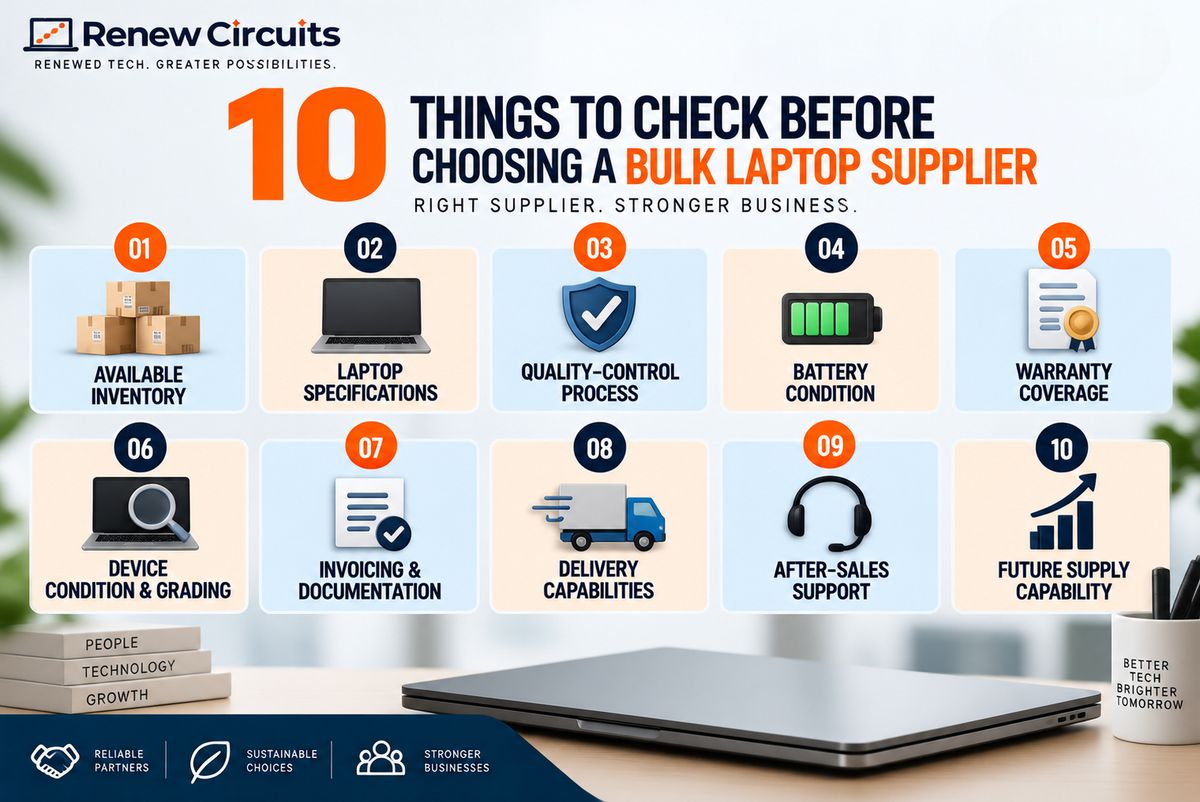
4. Battery Condition
Battery requirements vary according to how employees work.
For desk-based users, battery performance may be less critical. For sales or remote teams, it can be an important consideration.
Ask how battery condition is assessed and what standard applies to the devices being quoted.
5. Warranty Coverage
Do not treat “warranty included” as sufficient information.
Ask:
- What is the warranty period?
- Which components are covered?
- Are there exclusions?
- How is a claim submitted?
- Who pays for shipping when service is required?
- Is the device repaired or replaced?
Clear warranty terms reduce uncertainty after deployment.
6. Device Condition and Grading
For refurbished laptops, understand how cosmetic condition is classified.
Ask whether devices may have scratches, dents or other signs of previous use and what condition you should expect across the order.
Functional condition and cosmetic condition should be evaluated separately.
7. Invoicing and Documentation
B2B buyers should confirm invoicing requirements before finalising a purchase.
Clear documentation helps accounting and IT teams maintain accurate procurement and asset records.
8. Delivery Capabilities
Ask whether the supplier can deliver the entire order within the required timeframe.
For organisations with distributed teams, also determine whether delivery requirements can be coordinated appropriately.
Avoid assuming that a supplier capable of delivering five laptops can automatically fulfil a much larger deployment within the same timeline.
9. After-Sales Support
A corporate procurement relationship should not necessarily end when the order arrives.
Ask how the supplier handles:
- Technical issues
- Warranty claims
- Repairs
- Replacements
- Additional device requirements
This is particularly important for organisations without large internal IT support teams.
10. Ability to Support Future Requirements
Think beyond the current order.
If your company expects to hire additional employees, ask whether the supplier can provide similar models or configurations in the future.
A supplier that understands ongoing B2B requirements may be more useful than one focused only on completing a single transaction.
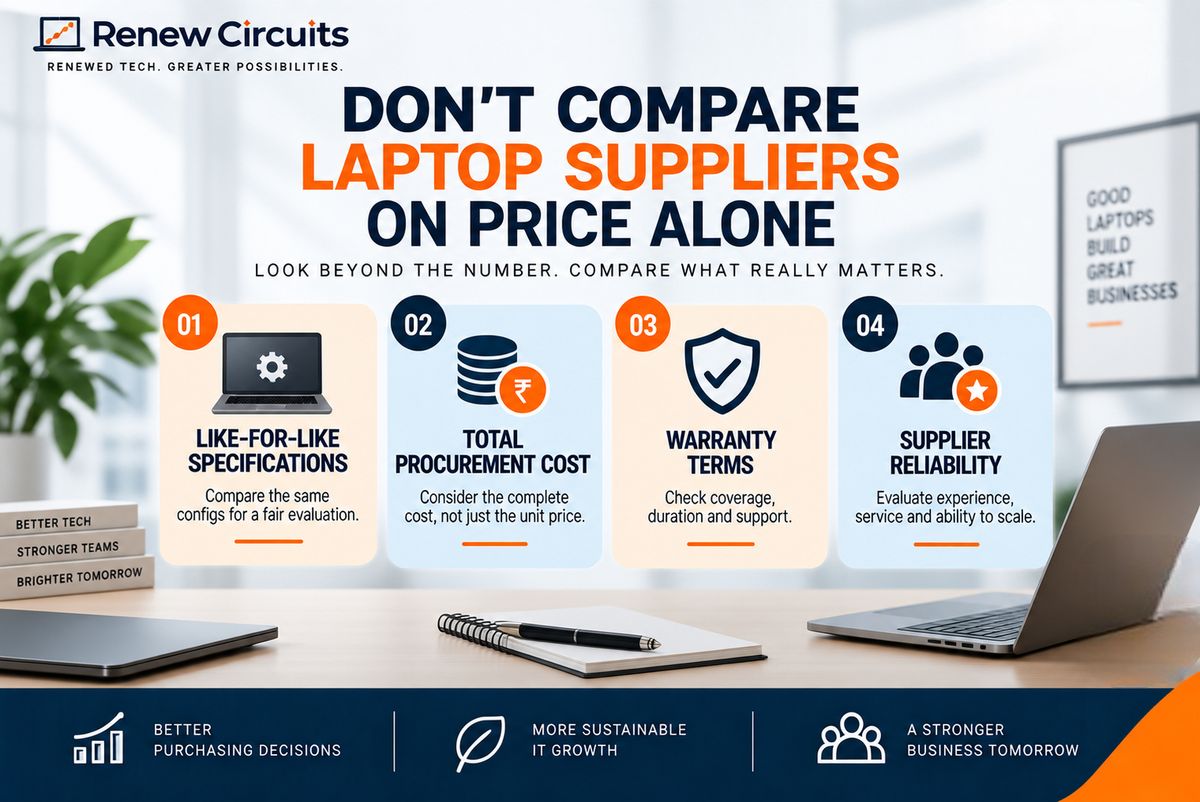
How to Compare Quotes from B2B Laptop Suppliers
Once you have quotations from multiple bulk laptop suppliers in India, compare them using the same framework.
Compare Like-for-Like Hardware
A ₹2,000 or ₹5,000 difference between quotations means little if the underlying devices have different processors, RAM or storage.
Normalise the specifications first.
Calculate Total Procurement Cost
Look beyond the per-device price.
Consider factors such as:
- Laptop cost
- Required upgrades
- Delivery
- Warranty
- Support
- Accessories
- Potential replacement requirements
This provides a more useful picture than comparing unit prices alone.
Review Warranty Terms Side by Side
Create a simple comparison of warranty duration, coverage and claim procedures.
The cheapest quotation may not provide the best overall procurement value.
Consider Supplier Reliability
Price matters, but so do fulfilment, communication, documentation and support.
A delay involving dozens of devices can affect employee onboarding and productivity.
Which Laptop Specifications Should Businesses Buy?
The correct specification depends on employee workloads.
Businesses should avoid buying one expensive configuration for every employee simply for the sake of standardisation.
General Office Employees
Employees primarily using email, documents, spreadsheets, web applications and video meetings generally need reliable everyday performance.
Sales and Remote Teams
Consider portability, webcam functionality, connectivity and battery requirements in addition to general productivity performance.
Developers
Development teams may require additional RAM, stronger processors and larger SSDs depending on their development tools and workloads.
Creative Professionals
Design, editing and other creative applications may require significantly more processing power, memory or graphics capability.
Before requesting quotations, confirm application requirements with the relevant team.
Common Mistakes When Choosing a Corporate Laptop Supplier
Avoiding a few common mistakes can make procurement considerably smoother.
Selecting the Cheapest Supplier Automatically
Low prices can be attractive, but hardware quality, specifications, warranty and support should be considered together.
Ordering Without a Specification Sheet
If every supplier quotes a different configuration, comparing prices becomes difficult.
Define minimum requirements before requesting quotations.
Ignoring Inventory Consistency
Make sure the supplier can provide enough devices with similar configurations.
Not Checking Warranty Details
Understand warranty coverage before payment—not after a device develops a problem.
Buying More Performance Than Employees Need
A laptop should match the employee's workload.
Over-specifying devices across hundreds of employees can unnecessarily increase procurement costs.
Ignoring Future Requirements
If your organisation is growing, consider whether the supplier can support additional procurement later.
Bulk Laptop Supplier Evaluation Checklist
Before choosing a B2B laptop supplier in India, ask these questions:
- Can the supplier fulfil the required quantity?
- Are similar models and configurations available?
- What processor generation is included?
- How much RAM and SSD storage is provided?
- What operating system is installed?
- How are devices tested?
- How is battery condition evaluated?
- What cosmetic condition should be expected?
- What warranty is included?
- What is the warranty claim process?
- Are proper invoices available?
- What is the expected delivery timeline?
- What happens if a device arrives with an issue?
- Is after-sales support available?
- Can the supplier support future requirements?
This checklist makes it easier to compare multiple suppliers objectively.
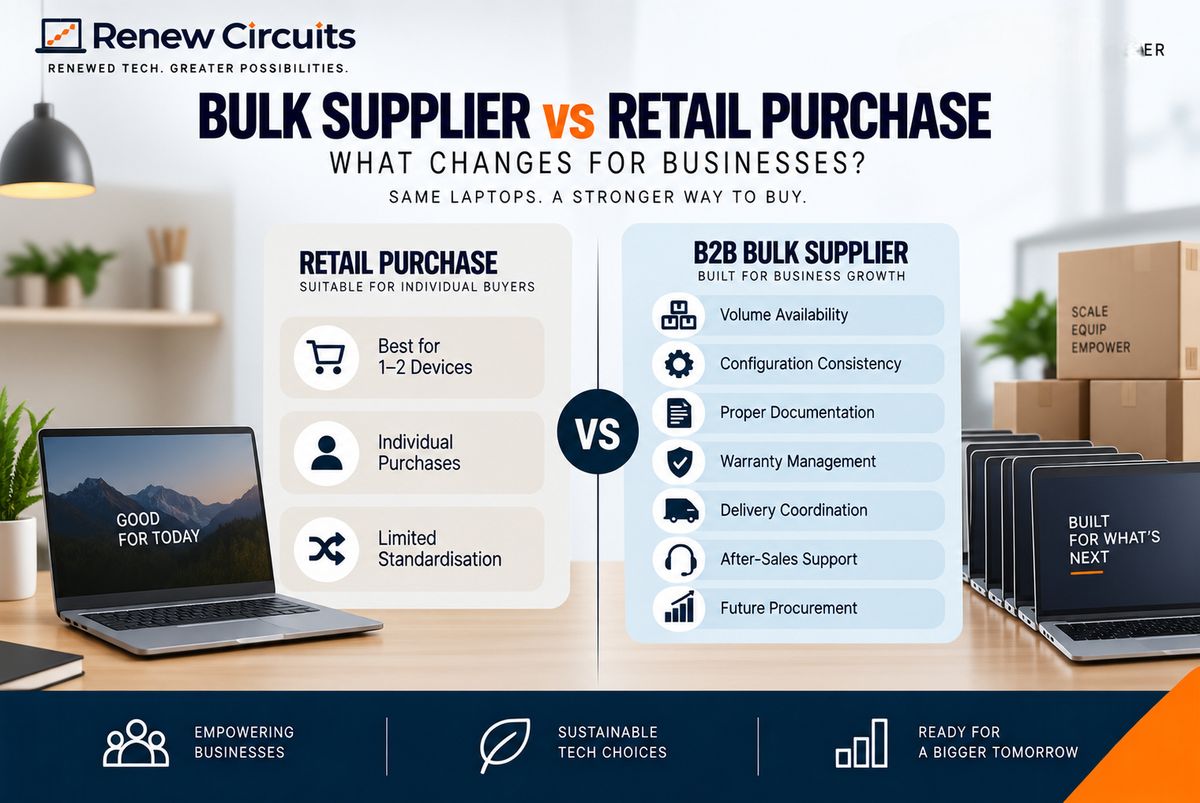
Bulk Supplier vs Retail Laptop Purchase: What's the Difference?
Retail purchasing can work when a company needs one or two devices.
As requirements grow, however, businesses need to think differently.
A corporate procurement process places greater emphasis on:
- Volume availability
- Configuration consistency
- Documentation
- Warranty management
- Delivery coordination
- After-sales support
- Future procurement
This is why businesses purchasing larger quantities may benefit from working with a supplier experienced in B2B requirements rather than treating every device as an individual retail purchase.
Where Renew Circuits Fits Into B2B Laptop Procurement
Renew Circuits works with organisations looking for refurbished laptops for business requirements.
Businesses can discuss factors such as quantity, preferred specifications, employee workloads and deployment requirements before selecting suitable devices.
For companies comparing bulk laptop suppliers in India, this means Renew Circuits can be evaluated not simply on individual laptop pricing, but on whether its available inventory, configurations and support meet the organisation's wider procurement requirements.
Specific availability, pricing, warranty terms, documentation and fulfilment timelines should be confirmed according to the order.
Choose a Laptop Supplier Based on Value, Not Just Price
Finding the right bulk laptop supplier in India involves much more than requesting the lowest quotation.
Businesses should evaluate device specifications, inventory consistency, quality checks, warranty terms, documentation, fulfilment and after-sales support before committing to a large order.
The goal should be straightforward: purchase devices that meet employee requirements while keeping procurement manageable for IT, finance and operations teams.
Whether you are equipping 10 employees or planning a larger deployment, a clear procurement specification and supplier evaluation process can help you make a more informed decision.
Looking for laptops for your organisation? Contact Renew Circuits to discuss your quantity, specifications and business requirements.
Frequently Asked Questions
1. How do I choose a bulk laptop supplier in India?
Compare suppliers based on available inventory, laptop specifications, device quality, warranty, documentation, delivery capability and after-sales support. Avoid making the decision solely on unit price.
2. What is a B2B laptop supplier?
A B2B laptop supplier provides laptops to businesses and organisations, often in larger quantities. Corporate requirements may also involve consistent configurations, documentation, warranty support and coordinated fulfilment.
3. Can businesses buy refurbished laptops in bulk?
Yes. Businesses can purchase refurbished laptops in bulk where suitable inventory is available. Before ordering, confirm specifications, testing procedures, device condition, warranty and quantity with the supplier.
4. What should I ask a corporate laptop supplier before ordering?
Ask about available quantity, processor generation, RAM, SSD, device condition, quality checks, battery standards, warranty, invoicing, delivery timelines and after-sales support.
5. Is a laptop wholesale supplier the same as a corporate laptop supplier?
Not necessarily. A wholesale supplier primarily focuses on selling larger quantities, while a corporate supplier may also provide services and processes designed around business procurement requirements. Capabilities vary between suppliers.