
Best Laptop Procurement Strategy for Startups: New vs Refurbished vs Rental
For a startup, every major purchase competes for the same limited pool of capital. Laptops are essential, but buying expensive new devices for every employee may not always be the smartest way to build your IT infrastructure.
As teams grow, founders and operations managers need to decide whether they should buy new laptops, choose professionally refurbished devices or rent hardware according to their workforce requirements.
If you are evaluating laptops for startups in India, the right procurement strategy depends on your budget, team size, employee workloads, expected growth and how long the devices will actually be required.
This guide compares new, refurbished and rental laptops to help startups build a more practical laptop procurement strategy.
Why Laptop Procurement Matters for Startups
In an established organisation, IT procurement may follow a predictable annual budget and replacement cycle.
Startups often operate differently.
Hiring can accelerate quickly. Teams may expand or contract. Employees may work remotely. Contractors may join for individual projects. And the hardware requirements of developers can be very different from those of sales or operations teams.
A structured procurement strategy can help startups avoid two common problems: spending too much on unnecessary hardware and buying devices that cannot adequately support employees' workloads.
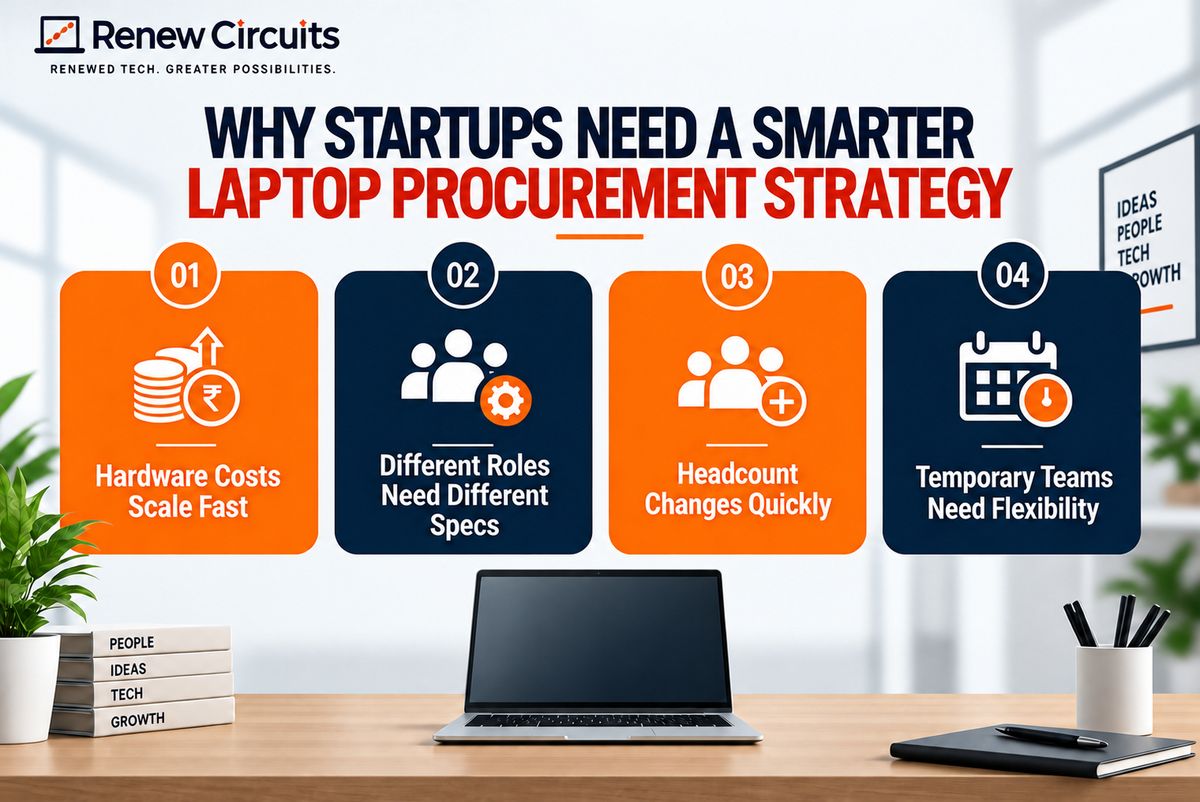
Hardware Costs Increase Quickly as Teams Grow
Buying one laptop may not seem like a significant business expense.
But when a startup needs devices for 10, 20, 50 or more employees, the total cost can become substantial.
This makes it important to determine how much performance each employee actually needs before purchasing hardware.
Not Every Employee Needs the Same Laptop
A startup's employees may have very different technology requirements.
For example:
- Sales teams may primarily use browsers, CRM platforms and video meetings.
- Operations teams may rely on spreadsheets and business applications.
- Developers may require additional RAM and processing power.
- Designers and video editors may need significantly more powerful systems.
- Founders and travelling employees may prioritise portability and battery performance.
Buying the same premium laptop for everyone can therefore lead to unnecessary expenditure.
Startup Headcount Can Change Quickly
A startup expecting rapid growth may need several additional devices within a short period.
At the same time, temporary employees, interns and contractors may only require hardware for a limited period.
Planning for both permanent and temporary requirements can make laptop procurement more efficient.
Three Ways Startups Can Procure Laptops
Most startups can consider three broad approaches:
- Buying new laptops
- Buying refurbished laptops
- Renting laptops
Each option has different advantages depending on the business requirement.
Option 1: Buying New Laptops for a Startup
Buying new devices is the most straightforward procurement model.
The startup purchases the laptops and owns them throughout their useful life.
Advantages of Buying New Laptops
New laptops may provide:
- Latest-generation hardware
- Full manufacturer warranty
- Access to newer features
- Predictable cosmetic condition
- Wider configuration choices
- Longer potential ownership period
For employees with demanding workloads, newer hardware may also provide access to performance or features unavailable on older systems.
When New Laptops Make Sense for Startups
Buying new may be appropriate when:
- Devices will be used for several years
- Employees require latest-generation hardware
- Specialised configurations are necessary
- Manufacturer-specific support is important
- The startup has predictable long-term hardware requirements
Potential Limitation for Startups
The primary challenge is upfront cost.
Purchasing new laptops for every employee can consume a meaningful portion of a growing startup's technology budget.
Startups should therefore avoid assuming that every employee automatically requires a new premium device.
Option 2: Buying Refurbished Laptops for a Startup
Professionally refurbished laptops provide another option for startups looking to balance performance and procurement costs.
A refurbished laptop is a previously used device that has been inspected and tested before being offered for resale.
Startups can explore refurbished laptops when suitable business configurations are available.
Advantages of Refurbished Laptops
Refurbished laptops can help startups:
- Reduce upfront hardware expenditure
- Access established business-class laptop models
- Equip larger teams within a defined budget
- Match hardware spending more closely to employee requirements
- Extend the useful life of existing technology
The value depends heavily on the device specifications, condition, testing process and warranty provided by the supplier.
Business-Class Laptops for Startup Teams
Business laptop families such as Dell Latitude, Lenovo ThinkPad and HP EliteBook are commonly considered for professional workloads.
Rather than focusing only on the brand or model name, startups should evaluate the processor generation, RAM, SSD, battery condition, connectivity and overall device condition.
When Refurbished Laptops Make Sense
Refurbished laptops may be suitable when:
- The startup needs multiple devices
- Employees mainly perform everyday business workloads
- Cost efficiency is important
- Suitable business-class configurations are available
- The supplier provides clear testing and warranty information
What Startups Should Check Before Buying Refurbished
Before placing an order, check:
- Processor and generation
- RAM
- SSD capacity
- Battery condition
- Display
- Keyboard and trackpad
- Webcam
- Wi-Fi and Bluetooth
- Required ports
- Operating system compatibility
- Device condition
- Quality-control process
- Warranty terms
The cheapest refurbished laptop is not necessarily the best option. Specifications, testing and support should be considered together.
Option 3: Laptop Rental for Startups
Not every employee needs a permanently owned device.
Startups may have interns, contractors, consultants, temporary project teams or rapidly changing workforce requirements.
In these situations, laptop rental can provide an alternative to purchasing additional devices.
Advantages of Renting Laptops
Rental can be useful because it allows startups to:
- Avoid purchasing hardware for temporary requirements
- Reduce upfront capital requirements
- Add devices as temporary teams grow
- Equip contractors and interns
- Support short-term projects
- Return devices after the requirement ends
When Laptop Rental Makes Sense
Rental may be worth considering when:
- Employees are temporary
- Contractors need company-provided devices
- Interns join for a fixed period
- A project requires additional hardware
- Team size is changing rapidly
- Devices are required for a defined period
When Rental May Not Be the Best Option
Rental is not automatically cheaper.
If a startup expects to use the same device for several years, purchasing may provide better long-term value.
The correct comparison is therefore not simply:
Rental price vs purchase price
Instead, compare:
Total rental cost over the required period vs total cost and expected useful value of purchasing the device.
New vs Refurbished vs Rental: Which Is Better for a Startup?
There is no single procurement model that works for every startup.
The decision should depend on the specific employee and business requirement.
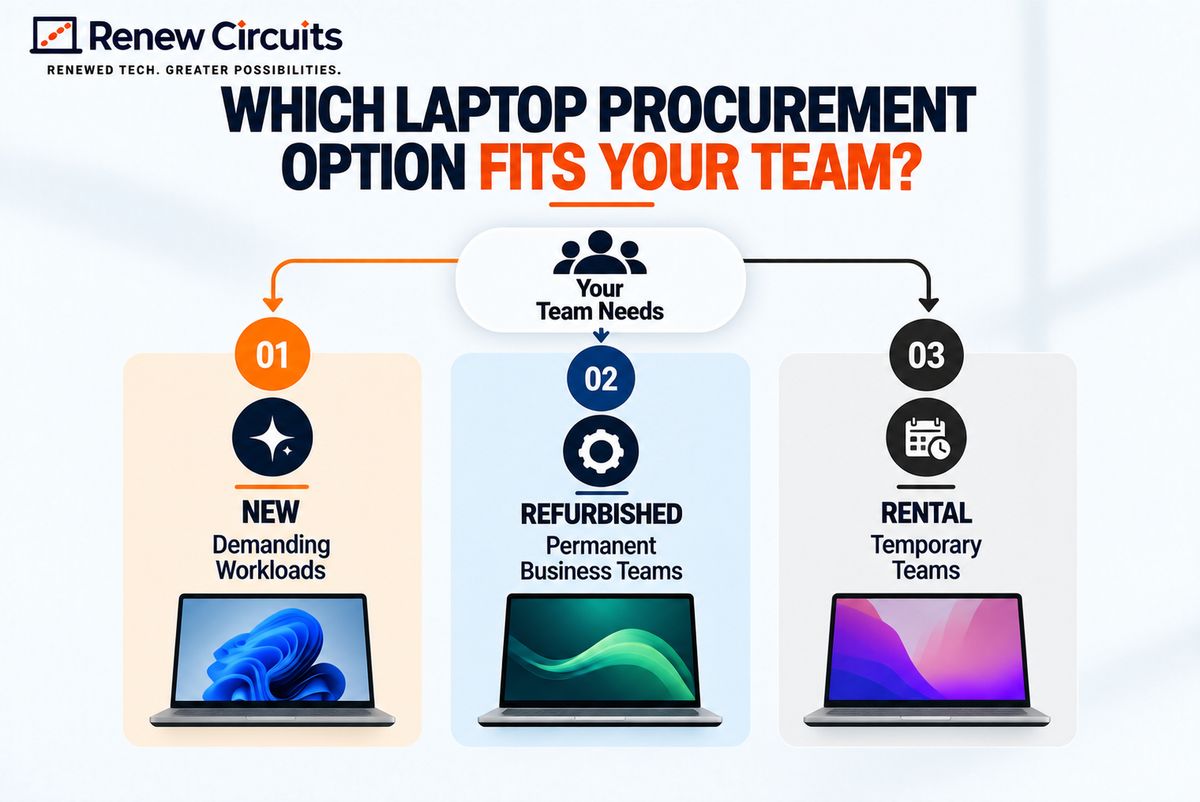
Choose New Laptops When
Consider new laptops when:
- Latest hardware is required
- Employees perform demanding workloads
- Devices will be used for several years
- Specialised configurations are necessary
- Long-term ownership is preferred
Choose Refurbished Laptops When
Consider refurbished laptops when:
- You need cost-efficient permanent devices
- Employees have standard business workloads
- Business-class configurations meet your requirements
- You are equipping multiple permanent employees
- You want to reduce upfront procurement expenditure
Choose Laptop Rental When
Consider rental when:
- Requirements are temporary
- Contractors or interns need devices
- Team size changes frequently
- Hardware is required for a project
- The future requirement is uncertain
A Hybrid Laptop Procurement Strategy for Startups
Startups do not necessarily need to choose only one option.
In many cases, a hybrid strategy can align hardware spending more closely with employee requirements.
Developers and Creative Teams
Employees with demanding technical workloads may require newer or higher-performance systems.
New devices may therefore be considered where the required specifications cannot be met effectively by available refurbished inventory.
Permanent Business Teams
Sales, HR, operations, customer support and other general business teams may be able to use suitable refurbished business laptops.
The decision should still be based on actual applications and performance requirements.
Interns and Temporary Employees
Rental may make more sense when employees will only be with the organisation for a defined period.
Contractors and Project Teams
If additional devices are needed specifically for a short-term project, renting can prevent the startup from being left with unused hardware once the project ends.
This hybrid approach means the company does not have to apply the same procurement method to every employee.
How to Choose Laptop Specifications for Startup Employees
Before deciding whether to buy or rent, determine what employees actually need.
General Business Users
Employees using email, documents, spreadsheets, web applications and video meetings usually require dependable everyday performance.
Consider:
- Suitable processor
- Sufficient RAM
- SSD storage
- Webcam
- Wi-Fi and Bluetooth
- Required ports
Sales and Remote Teams
For employees who travel or work remotely, consider:
- Portability
- Battery performance
- Webcam
- Wi-Fi
- Bluetooth
- Display quality
- Required connectivity
Developers
Development teams may require:
- Stronger processors
- Additional RAM
- Larger SSDs
- Multiple connectivity options
Exact requirements depend on the development environment and software being used.
Designers and Creative Teams
Graphic design, animation and video-editing applications can require substantially more powerful hardware.
Startups should check software requirements before choosing devices for these teams.
How to Build a Laptop Procurement Budget for Your Startup
A good hardware budget begins with employee requirements rather than laptop models.
Step 1: Estimate Headcount
Determine:
- Current employees
- Confirmed new hires
- Expected hiring
- Contractors
- Interns
- Temporary project staff
Step 2: Create Employee Categories
Group employees according to workload.
For example:
- General business
- Sales and remote
- Technical
- Creative
Step 3: Define Minimum Specifications
Create a standard configuration for each employee category.
This makes supplier quotations easier to compare and reduces unnecessary hardware spending.
Step 4: Decide Whether Each Category Should Buy or Rent
Ask how long the device will be required.
Permanent employees may justify purchasing, while temporary requirements may be better suited to rental.
Step 5: Compare Procurement Options
For permanent devices, compare new and professionally refurbished alternatives.
For temporary requirements, compare the total rental cost against purchasing.
What Should Startups Look for in a Laptop Supplier?
Choosing the right supplier becomes increasingly important as order quantities grow.
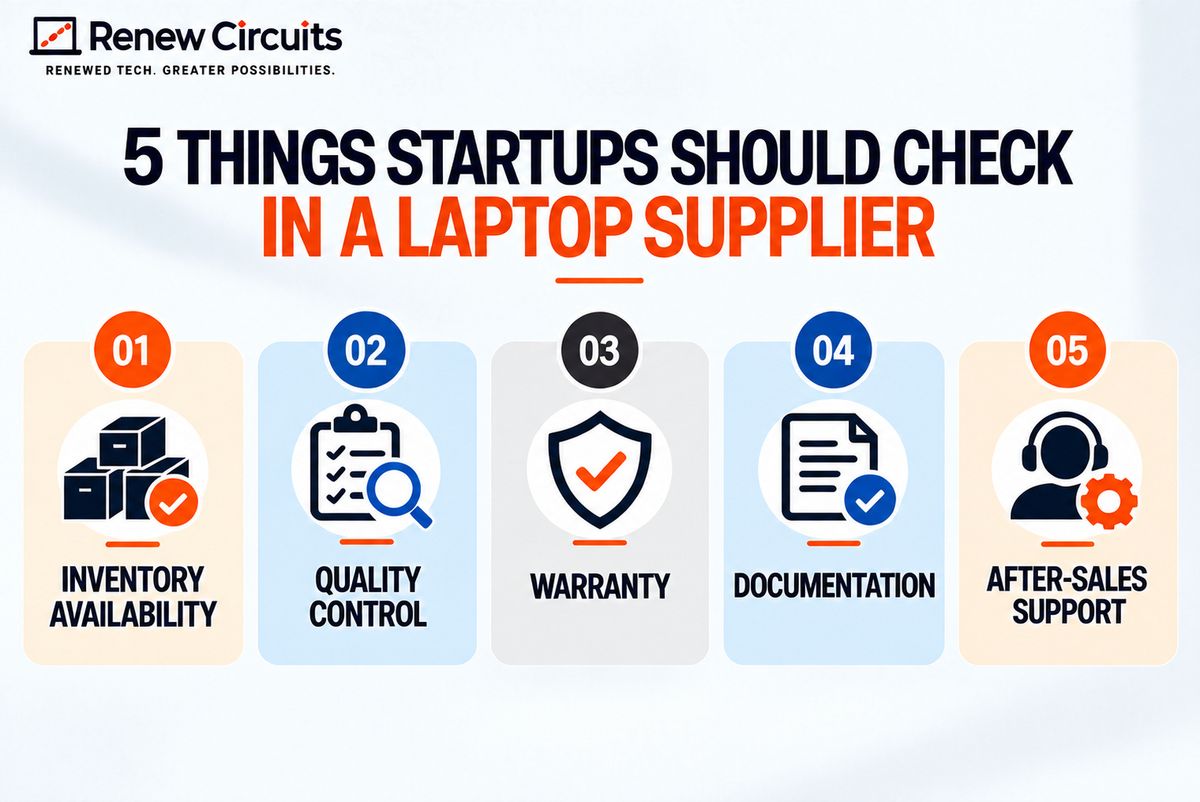
Inventory Availability
Ask whether the supplier can provide the number of devices required.
If standardisation matters, confirm whether similar models and configurations are available.
Quality-Control Process
When purchasing refurbished devices, understand how laptops are tested before dispatch.
Ask how important components such as storage, RAM, display, keyboard, battery, webcam, connectivity and ports are checked.
Warranty
Understand:
- Warranty duration
- Coverage
- Exclusions
- Claim procedure
- Repair or replacement process
Warranty terms should be reviewed before placing an order.
Invoicing and Documentation
Startups should maintain clear purchasing and asset records as they scale.
Confirm invoicing and documentation requirements with the supplier.
After-Sales Support
Understand how hardware issues will be handled after deployment.
This becomes especially important for startups without a large internal IT team.
Common Laptop Procurement Mistakes Startups Should Avoid
Hardware decisions made during rapid growth can create unnecessary costs later.
Buying Premium Laptops for Everyone
Different employees have different requirements.
Matching hardware to workloads can help prevent unnecessary expenditure.
Choosing the Cheapest Laptop Available
Price should be considered alongside specifications, condition, warranty and expected use.
A device that cannot support an employee's workload is not a good procurement decision simply because it costs less.
Buying Temporary Employees Permanent Devices
Before purchasing hardware for contractors or temporary employees, consider whether rental would better match the duration of the requirement.
Ignoring Future Hiring
Startups should consider expected hiring when planning procurement.
Frequent emergency purchases can create inconsistent hardware and make budgeting more difficult.
Ignoring Warranty and Support
Support becomes more important as the number of devices increases.
Understand warranty and replacement procedures before placing larger orders.
Frequently Asked Questions
1. What are the best laptops for startups in India?
There is no single laptop that is best for every startup. The right device depends on employee workloads, required applications, budget, portability and expected usage period. Startups should create different hardware profiles for general business, technical and creative employees.
2. Should startups buy new or refurbished laptops?
Both options can be suitable. New laptops may make sense when the latest hardware or specialised configurations are required, while professionally refurbished laptops can be considered when suitable business specifications are available and cost efficiency is important.
3. Is laptop rental a good option for startups?
Laptop rental can be useful for temporary employees, interns, contractors, project teams or situations where future device requirements are uncertain. Businesses should compare the total rental cost with the cost and expected useful life of purchasing.
4. Are refurbished laptops suitable for startup employees?
They can be suitable when the specifications, condition and performance meet the employee's workload. Startups should also evaluate the supplier's testing procedures, warranty and support.
5. Should startups rent laptops for interns?
Rental can be considered when interns require devices for a fixed period and the business does not expect to need those laptops afterwards.